Finished Object – Baby Dinosaur

This little Baby Dinosaur by Complicated Knots was equally deceptively difficult and deceptively easy at the same time, and I can’t exactly explain it.


A crocheted baby dinosaur made in various shades of blue, teal, and purple, sits on a wooden table facing the camera.


It’s made in parts, a stuffed main body piece, head overlay, two arms, two mirrored legs, and a back panel, and then sewn together at the end.


The right side of the baby dinosaur.

I actually finished most of the pieces long before I sewed it together because I pulled one of those “putting off the easy part” moves.


The left side of the baby dinosaur.

It’s made of partial mini-skeins of Knit Picks Brava, hence way more colors than the two colors it’s supposed to be, and the back piece is slightly scrunchy, but it turned out super cute. It was very confusing, however, that I decided to pick the opposite colors of the original (blue as my dark color and purple as the light) because I would occasionally get mixed up seeing her pick up the purple where I was supposed to be using blue or vice versa.

The back of the baby dinosaur.

It was definitely fun to explore the different shaping techniques like using surface crochet to curve the legs, and to know that other people use the same “make a bunch of fingers and stick them together to make a hand” technique that I tend to use for creating hands and feet.

While this is not a beginner-friendly pattern, I would say don’t be scared to try it if it looks interesting and you have made a few Amigurumi before. My one tip is just for my fellow lefties:  when it comes to the back legs, the one you make for the “left” instructions will go on the right of the dinosaur and the “right” on the left. This is visible once the legs are finished and ready to sew on, but it might be good to remember while you are working on them.


Follow me on Instagram and Ko-fi.

Finished Object – Scrap Blanket

I present my second finished and washed scrap blanket.

A blanket with diagonal stripes of varying lengths, widths, and colors with a blue and green border laying across the top of a bed.

It’s made of all the unknown scraps from my stash box, so it’s definitely got a few bits that felted slightly in the wash. But not enough to affect it too much. 

A black dachshund puppy laying on the blanket piled up on the bed.

It’s definitely passed the puppy test. In fact, it’s passed the puppy test so well that he’s basically claimed it as a nap spot and I’ve taken to leaving it and most of the rest of my blankets on the floor at the end of my bed as his cozy area.

A ball of triple-stranded yarn with each strand a different color, the outer layer with two shades of pink and black, and inner layers involving blues, purples, yellows, and oranges in addition to the black strand.

Like I said, this was random scraps, so I don’t actually have a lot of precise info, but I can outline the general process. The base is a C2C blanket. I think this is the tutorial I learned from a few years ago, though if it isn’t I still think it’s a good, comprehensive one: C2C blanket blog post tutorial from Sarah Maker. I started in my heavier worsted weight yarns and used the magic knot method to create a ball of yarn to work from and add subsequent balls of yarn created the same way. With my thinner scraps I just used more strands together to get the right thickness. I “measured” by laying it on my bed and working until one side went across the foot of the bed, then turned one corner while lengthening the other side until it was as long as the bed before turning to make the final corner. 

The inner portion of the blanket before the border was added laying on a light wooden floor.

Once the middle had four finished corners, I took apart another C2C blanket that had been abandoned for a very long time because I ran out of the colors and used it to crochet a 6-row border around the outside using a pattern from the Crochet Every Way Stitch Dictionary and making up the corners.
Scrap blankets are my favorite way to use up scraps, especially if you are like me and just have an entire box you need to use up. I just probably would suggest that, unlike me, you wait until the heat wave dies down before you start working on one.


Follow me on Instagram and Ko-fi.

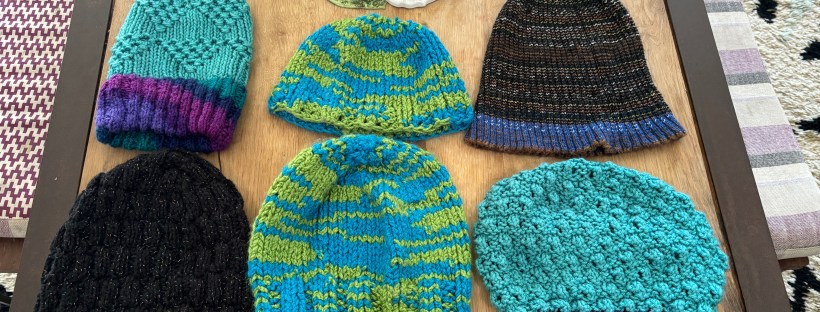
Six knit hats laid out in two rows of three. From top left: light blue body with triangles of textured stitches and a ribbed brim in shades of purple, a plain hat with puddles of green and blue, a brown and black striped ribbed beanie with blue stripes in the brim, a bubble-stitch teal hat with black and neon blue, purple, green, and pink striped brim, another green and blue hat from the same yarn as the one above it, and a sparkled black hat with short teal brim.

September Hat Roundup

(Image description: Six knit hats laid out in two rows of three. From top left: light blue body with triangles of textured stitches and a ribbed brim in shades of purple, a plain hat with puddles of green and blue, a brown and black striped ribbed beanie with blue stripes in the brim, a bubble-stitch teal hat with black and neon blue, purple, green, and pink striped brim, another green and blue hat from the same yarn as the one above it, and a sparkled black hat with short teal brim.)

September’s official hat count is six. Technically there are a few sitting here next to me that are finished and waiting for ends to be woven, but since they will be coming out of the bath in October, I’m counting those for October. These hats are made from a combination of scraps, reclaimed abandoned projects, and a couple partial skeins I found in the bag with the abandoned projects.

To keep this easy on me, I’m just going to go clockwise from top left in these explanations. We start out in the top left with a combination of a reclaimed baby hat and one of those found skeins. Process: Provisional cast-on 80 stitches with size US 8 needles, knit until I ran out of the purple and green variegated yarn, which pool-striped nicely at this gauge, and then bring the bottom up to create a doubled brim, switching to size US 10 needles and the teal yarn. Then I worked pattern 18 from “Keiko Okamoto’s Japanese Knitting Stitches” (pg. 13) four times around and repeating all 16 rows twice. Then I worked it in a modified manner across the decreases for the crown, but if I do this again I’d just knit the crown instead of carrying the pattern up.

Next we have the green and blue hats, which I’ll explain together because they are literally the same thing. The yarn for these is reclaimed from a C2C pattern I was creating that I ran out of yarn for. I created a magic knot ball and used some of it for the border of my scrap blanket. Then I decided to chain the entire rest of it, and use that to knit as many hats as possible, which turned out to be a large and a small one. I started each at the top with a crocheted magic ring before picking up
the stitches on knitting needles (size US 13, I think) and knitting a fairly basic hat pattern. You can find a reel of bits of the process here.

Last across the top row is the sock-weight scrap hat I’ve been working as my on-the-go project for a while using the helical knitting method to make sure I ran out of all the yarn at the same time and give the nice stripe pattern I ended up with.Below that is another hat in a similar manner to the first hat, but with an extra 8 stitches to make it a large (going for a fairly even mix of medium and large adult sizes
with some small mixed in), and using pattern 11 (pg. 11 / 45).

Our last hat, bottom left, is the same at the previous hat, using pattern 24 (pg. 15), though it may be difficult to see in the sparkly black yarn.

I’ve gotten into another set of reclaimed yarn from a sweater that was entirely too warm for me to wear ever, so I’m hoping to at least make another 6 for October. I’ve got another blanket to take apart, as well.


Follow me on Instagram and Ko-fi.