Rainbow Hearts Galore

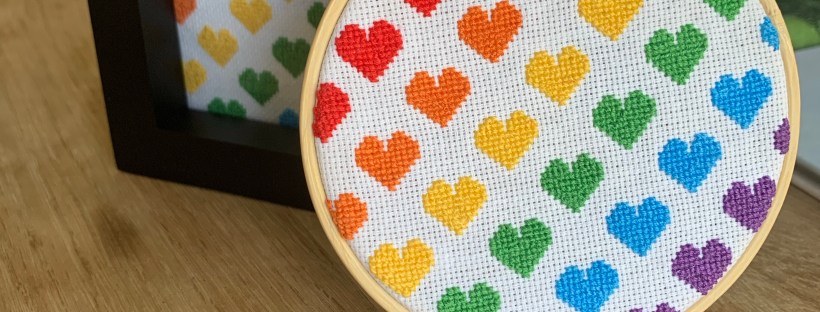
Ok, I had planned this to happen way back at the beginning of the month, but then I kept changing my mind on how to do certain things and what I wanted to be in the boxes. But it’s done and out now: Rainbow Heart Cross Stitch Kits and my Rainbow Heart Cross Stitch PatternsCircle and Square!

I have really been focusing hard on this for the past week once I decided how I wanted to make the “getting started” guide. You don’t have to purchase a pattern or kit to get that guide, just click here!

I had originally wanted to film all the videos myself, but I decided to go ahead and find videos that already existed to use with the guide now and film my own tutorials to add to it later on because I really wanted to finally launch these.

The patterns themselves are available in my Ko-Fi Shop, while the kits are available on Etsy. Any purchase in my Ko-Fi shop over $3 unlocks all supporter exclusives for 30 days which means any pattern purchase, single pattern or the double pattern bundle, gets you exclusive downloads, too!

I’m so excited to finally share these with you all, and hope you love them as much as I do!


Cross Stitch Materials List

You really don’t require many supplies to begin cross stitching. If you already embroider, you will probably only need to pick up the correct fabric from a local craft store, or even Amazon. Here is my list of needs and wants when it comes to starting cross stitch:

  • Aida fabric in the count called for on the pattern. The count tells you how many stitches will be in each inch in your finished project. If you want to make a project a different size, you can use a cross stitch calculator like this one from Yarn Tree to decide what count of fabric to use or how big your final piece will be.
  • Embroidery thread or floss. The easiest to find is DMC cotton thread, which comes in 6-strand skeins. You can find many different ways to store your floss, from keeping it in the skein to wrapping it on plastic bobbins or even making your own bobbins from scrap cardboard you may have laying around.
  • Embroidery needle. These needles will typically have a slightly larger eye and sharp point, but you can also find ones with duller points since you will be going through the holes in the weave of the fabric.
  • Scissors. Really, you can use any scissors you have around the house for cutting your threads, but you may find it easier to cut, especially when using fewer than six strands, with small embroidery scissors. Overall, your best bet is with sharp scissors, because dull ones will take more effort and leave behind more fraying, making it difficult to thread your needle.
  • Marking pen. I tend to use a water-erasable fabric pen, but other people use Frixion pens which are heat-erasable.
  • Optional: Embroidery hoop or Q-snap frame. It makes it much easier to get consistent stitches when your fabric is held taught in a hoop or frame, but these aren’t actually necessary. It is entirely possible, especially when working with a stiff fabric like Aida, to hold the fabric in your hand and stitch it. Sometimes, if you are working with a smaller piece of fabric, it can even be easier to skip the hoop for stitching and use it solely for displaying the finished piece.
  • Optional: Project bag. Whether a repurposed grocery bag, a special fabric pouch, or even a dedicated basket, it can be helpful to have a specific place to keep all your cross stitch supplies related to your project. If you plan on working on more than one project at a time, it is especially helpful to keep each project’s supplies together in one place.
  • Optional: Needle Minder. A needle minder is a set of two strong magnets, often with a cute picture on the top piece, that you sandwich your fabric in so you have a place to set the needle when you aren’t working on your piece. I tend to stick my needles to the magnets on the edge of my laptop or iPad case while getting more thread and stick the needle in the fabric when I/m not working on it at all, but many people find it helpful to have a needle minder.
  • Optional: Hoop or frame stand. These are helpful when doing long projects, but can also be helpful on quick projects. They come in floor and chair models, and hold your hoop to either free up both hands for stitching or just to not cause pain in the hand you would normally use for holding the hoop. Again, not a necessary item, but definitely can be helpful in the long run.

A Double-sided Halloween Pillow

When I joined the Snarky and Modern Facebook Group for the RBG Stitch Along, I found out that there was also an embroidery stitch along happening at the same time. I’ve been wanting to do more embroidery, so I decided to pick this one up as well. Here is the finished result:

As the opposite side of a scrap-stuffed pillow with this piece designed by 8.Bit.Stitch that I stitched last year:

I wasn’t entirely certain what I was going to do when I started, but luckily I made it on a large enough bit of fabric that it fit perfectly with the cross stitched piece I had finished a year earlier. It was a great way to work on some stitches I needed to practice, like French knots.

I think I can finally say I’ve got the hang of the French knot after not being able to do them consistently ever.

I really like the way it turned out on the dark purple, even if it was difficult to see the lines on the water soluble stabilizer. Though some of that difficulty may have stemmed from the fact I didn’t have the printable type and instead had to use some from a roll I had laying around. I don’t think it was meant to be used for pattern transfers.

It worked, though. I printed the pattern on paper, originally intending to trace it directly onto the fabric with a water-removable fabric pen, but I couldn’t see the pattern through the fabric even on my lightbox’s highest setting. The clear stabilizer worked with the pattern traced in a micron pen. No marks were left once I washed it away, so it can work in a pinch if you happen to have it on hand.